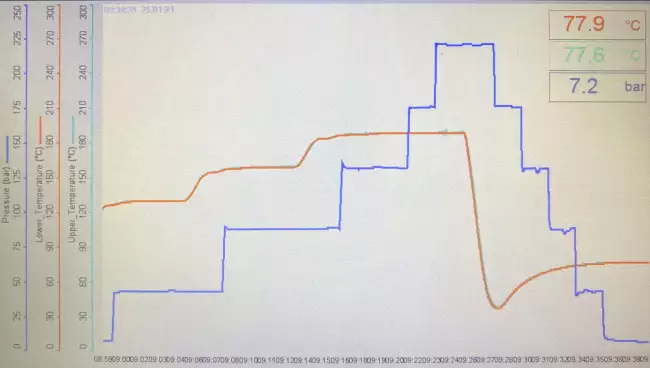
Setups of Moulding Cycles
The PLC for press control permits to set moulding cycles for each need


Cycles List 
Up to 40 cycles can be stored in the PLC.
The cycles can be saved in the Gibitre Standard database through the Gibitre_Press_Control software.


Cycle Preparation 
Each cycle allows you to enter up to 30 operations of:
- Mold opening
- Mold closure
- Wait
- Plates heating
- Platens Cooling

By pressing the green button for each line of the cycle-preparation page you can select the type of operation to be performed and activates the corresponding setting parameters.


Displacement Functions: Open, Close, Wait 
The commands allow you to manage the operations of mold closing, degassing, waiting during the vulcanization time, opening at the end of the cycle.
For all these operations it is possible to define the command execution time by setting the time in minutes, seconds and tenths of a second.


Closure with Controlled Force 
If your press is equipped with the Closing Force Control option, it is possible to prepare molding cycles by defining the force to be applied to the mold in each step.
In this case the menu allows you to define both the duration and the force to be applied for each cycle step.
The definition of the duty cycle can be combined with the definition of the thermal cycle to obtain elaborate combined cycles.


Temperature Control: Pre-set 
For each molding cycle you can define the Pre-set temperature to which the machine must be adjusted before the activation of the molding cycle is enabled.
This function guarantees repeatable molding conditions and high repeatability of the results obtained.
When the press is used in combination with the Gibitre Press-Control software, the preparation of the machine is carried out automatically based on the queue of products to be printed set in the software.
The tolerance limits for reaching the expected pre-set temperature can be set as needed.


Temperature Control: Heating 
Each heating step within a molding cycle allows to define:
- The temperature to be reached
- The thermal gradient (° C / min) with which to reach the required temperature. The temperature control PLC automatically adjusts the heating to achieve the required temperature change rate.
The heating elements installed on the press allow to obtain a Thermal Gradient up to 15 °C/min (the thermal mass of the mold and of the product to be heated can reduce the real heating rate obtainable).

In the same cycle, several temperature set operations can be inserted to configure the desired thermal cycle.

If the thermal gradient is not defined, the heating rate is optimized to reach the desired temperature in the shortest possible time.


Temperature Control: Cooling 
The cooling of the tops is necessary for the molding of thermoplastic products.
If your press is equipped with a cooling device, it is possible to set the automatic cooling phases of the plates.

Each cooling step within a molding cycle allows to define:
- The temperature to be reached
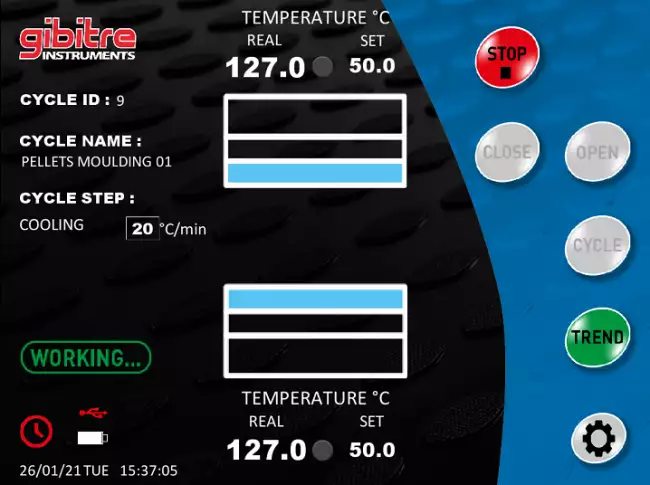
- The thermal gradient (° C / min) with which to reach the required temperature. The temperature control PLC automatically adjusts the flow of the cooling fluid independently in the two planes to achieve the required temperature change rate.


Gibitre Instruments
Via dell'industria, 18
Bergamo (Italy)
te. +39 035 461146
www.gibitre.it
info@gibitre.it

Copyright Gibitre Instruments
The PLC for press control permits to set moulding cycles for each need

Campi di applicazione  >  Prove su pneumatici  >  Rheocheck MD - Drive
Setups of
Moulding Cycles
lab press cycle: Prensa de laboratorio. Ejemplo de un ciclo de moldeo con una secuencia de operaciones automáticas de apertura, cierre y control de la temperatura.

The PLC for press control permits to set moulding cycles for each need

Cycles List 

Up to 40 cycles can be stored in the PLC.
The cycles can be saved in the Gibitre Standard database through the Gibitre_Press_Control software.
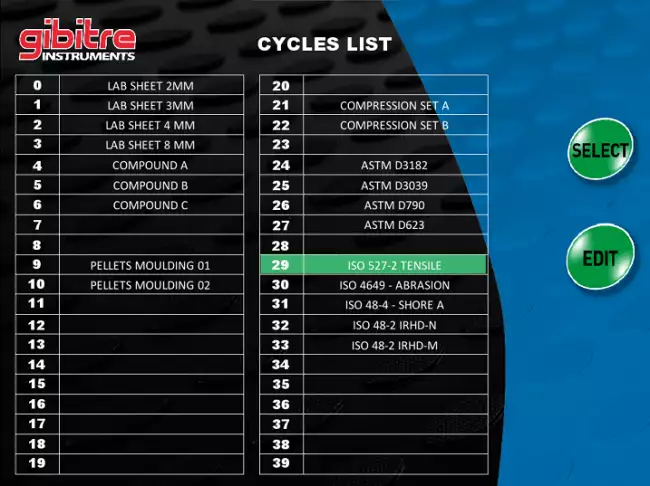
lab press cycle: Prensa de laboratorio. PLC de control. Lista de ciclos de moldeo almacenada y seleccionable.
Prensa de laboratorio. PLC de control. Lista de ciclos de moldeo almacenada y seleccionable.

Cycle Preparation 

Each cycle allows you to enter up to 30 operations of:
- Mold opening
- Mold closure
- Wait
- Plates heating
- Platens Cooling

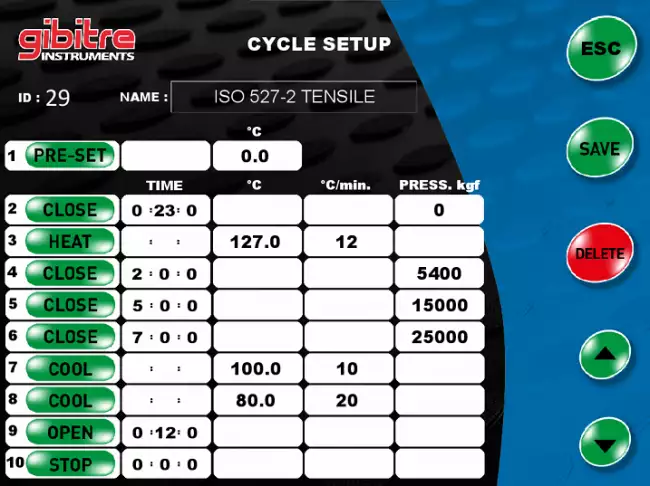
By pressing the green button for each line of the cycle-preparation page you can select the type of operation to be performed and activates the corresponding setting parameters.
lab press cycle: Prensa de laboratorio. PLC de control. Detalle de un ciclo de prueba almacenado para ejecución automática.
Prensa de laboratorio. PLC de control. Detalle de un ciclo de prueba almacenado para ejecución automática.

Displacement Functions: Open, Close, Wait 

The commands allow you to manage the operations of mold closing, degassing, waiting during the vulcanization time, opening at the end of the cycle.
For all these operations it is possible to define the command execution time by setting the time in minutes, seconds and tenths of a second.
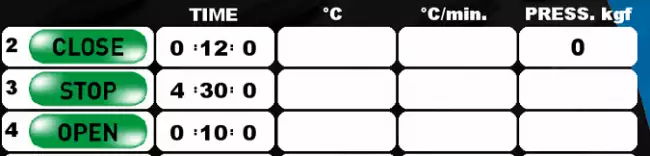
lab press cycle: Prensa de laboratorio. PLC de control. Detalle de un ciclo de prueba almacenado. Pasos de apertura y cierre de la platina.
Prensa de laboratorio. PLC de control. Detalle de un ciclo de prueba almacenado. Pasos de apertura y cierre de la platina.
 

Closure with Controlled Force 

If your press is equipped with the Closing Force Control option, it is possible to prepare molding cycles by defining the force to be applied to the mold in each step.
In this case the menu allows you to define both the duration and the force to be applied for each cycle step.
The definition of the duty cycle can be combined with the definition of the thermal cycle to obtain elaborate combined cycles.
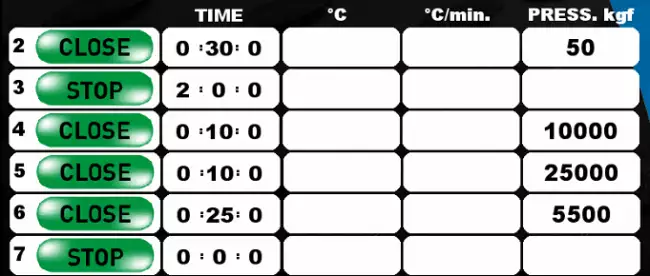
lab press cycle: Prensa de laboratorio con control opcional de la fuerza de sujeción. Ejemplo de ciclo de carga aplicado a la probeta con fuerzas de fijación crecientes. lab press cycle: Prensa de laboratorio con control opcional de la fuerza de sujeción. Ejemplo de ciclo de carga aplicado a la probeta con fuerzas de fijación crecientes. lab press cycle: Prensa de laboratorio: ejemplo de un ciclo con varios pasos de control de presión y temperatura.

Temperature Control: Pre-set 

For each molding cycle you can define the Pre-set temperature to which the machine must be adjusted before the activation of the molding cycle is enabled.
This function guarantees repeatable molding conditions and high repeatability of the results obtained.
When the press is used in combination with the Gibitre Press-Control software, the preparation of the machine is carried out automatically based on the queue of products to be printed set in the software.
The tolerance limits for reaching the expected pre-set temperature can be set as needed.
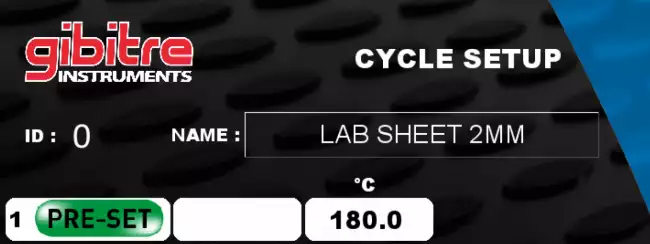
lab press cycle: Prensa de laboratorio. PLC de control. Detalle de un ciclo de prueba almacenado. Ajuste de las condiciones de preajuste de la máquina necesarias para el inicio del ciclo.
Prensa de laboratorio. PLC de control. Detalle de un ciclo de prueba almacenado. Ajuste de las condiciones de preajuste de la máquina necesarias para el inicio del ciclo.

Temperature Control: Heating 

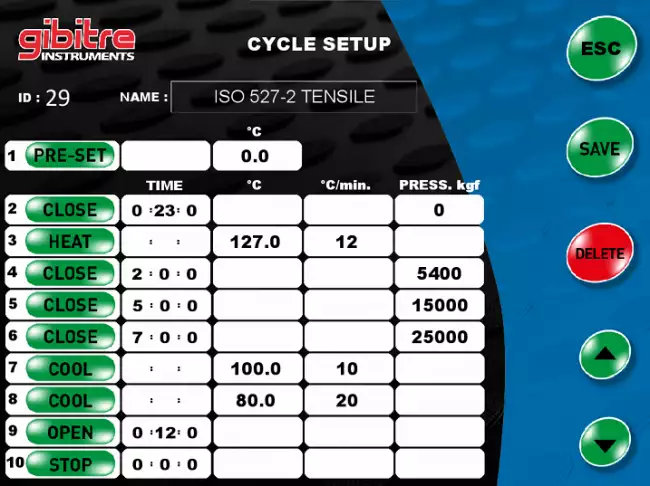
Each heating step within a molding cycle allows to define:
- The temperature to be reached
- The thermal gradient (° C / min) with which to reach the required temperature. The temperature control PLC automatically adjusts the heating to achieve the required temperature change rate.
The heating elements installed on the press allow to obtain a Thermal Gradient up to 15 °C/min (the thermal mass of the mold and of the product to be heated can reduce the real heating rate obtainable).

In the same cycle, several temperature set operations can be inserted to configure the desired thermal cycle.

If the thermal gradient is not defined, the heating rate is optimized to reach the desired temperature in the shortest possible time.
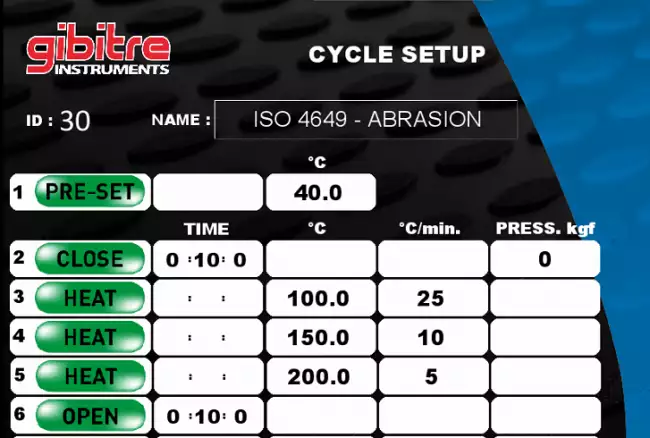
lab press cycle: Prensa de laboratorio. PLC de control. Detalle de un ciclo de prueba almacenado. Pasos de calentamiento sucesivos con diferentes gradientes y temperaturas objetivo.
Prensa de laboratorio. PLC de control. Detalle de un ciclo de prueba almacenado. Pasos de calentamiento sucesivos con diferentes gradientes y temperaturas objetivo.

Temperature Control: Cooling 

The cooling of the tops is necessary for the molding of thermoplastic products.
If your press is equipped with a cooling device, it is possible to set the automatic cooling phases of the plates.

Each cooling step within a molding cycle allows to define:
- The temperature to be reached
- The thermal gradient (° C / min) with which to reach the required temperature. The temperature control PLC automatically adjusts the flow of the cooling fluid independently in the two planes to achieve the required temperature change rate.
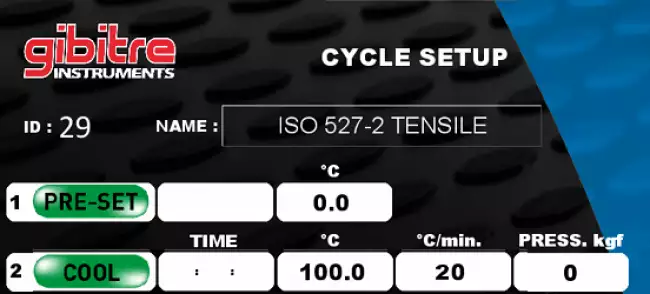
lab press cycle: Prensa de laboratorio. PLC de control. Detalle de un ciclo de prueba almacenado. Ajuste de un paso de enfriamiento controlado por velocidad. lab press cycle: Prensa de laboratorio. PLC de control. Detalle de un ciclo de prueba almacenado. Ajuste de un paso de enfriamiento controlado por velocidad. lab press cycle: Prensa de laboratorio. PLC de control. Página de visualización principal con ejemplo de refrigeración controlada por velocidad.
Download
General catalogue mail request

News
Call to action
Mail
info@gibitre.it
The good old e-mail
ready for every season
Phone
+39 035 460146
We welcome your calls Monday through Friday from 8:30 a.m. to 5:30 p.m. in your local time zone.
Newsletter
Subscribe
Stay updated
with the last news
of your sector
Local agent
from: -
See the whole list

In your country
in your language
at your service
Gibitre Instruments S.r.l., Via dell'industria 73, 24126 Bergamo Italia, pec@gibitre-instruments.it P. IVA: IT02827900164 CCIAA REA Bergamo: 326486 | ©2018 - 2026 Gibitre Instruments
Optimist.it
Welcome to the Gibitre Instruments web site
Please chose the preferred Cookie Management.
Benvenuti nel sito Gibitre Instruments
Per continuare scegliete la Gestione dei Cookie che preferite.
Cookies policy
For detailed informations about the use of cookies, please read our
Cookies Management Practice.

Gestione dei Cookies
Per maggiori informazioni sui cookie utilizzati consultate la nostra
Procedura sull'Uso dei Cookies.